Our interactive site needs JavaScript enabled. Here's where to go in the meantime.
How leadership teams turn connected systems into faster, better calls.
Company
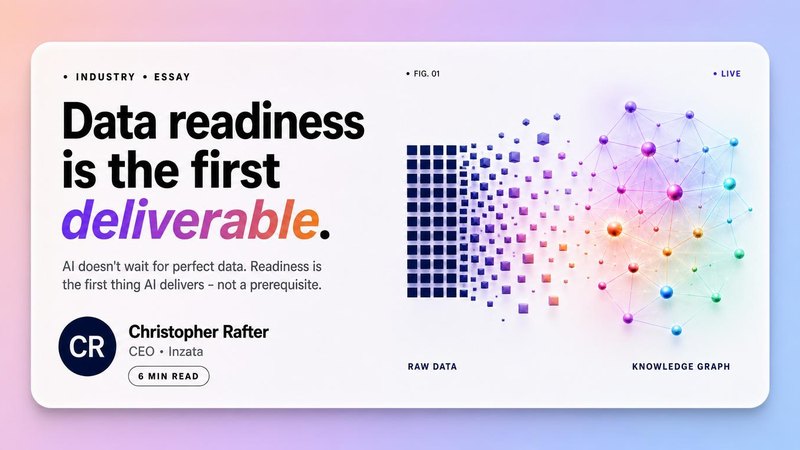
A CIO's playbook for jump-starting AI in a single quarter. Stop treating data readiness as the prerequisite. Make it the first thing AI delivers, and turn it into a compounding asset.
Christopher Rafter · Jul 15, 2026
SIGNLD proposes entity matches, metric definitions, and relationships automatically, then routes anything uncertain to a human for confirmation.
How SIGNLD's proactive discovery surfaces entities and relationships nobody has queried yet, and why a person still confirms each one. Here is how it works.
How proactive graph building changes what happens mechanically before your first answer, without claiming a new speed number. Here is how it works.
SIGNLD now builds the Knowledge Graph proactively from connected systems, instead of waiting for chat and usage to shape it over time. Here is how it works.
A step-by-step look at what SIGNLD does behind the scenes to build your Knowledge Graph the moment a system is connected. Here is how it works.
A direct comparison of manual knowledge graph building, where the graph learns from use, against proactive building, where it builds ahead of use.
A proactive knowledge graph builds itself from connected systems automatically, instead of waiting for a user to ask a question first. Here is how it works.
Every knowledge graph term a business buyer needs, defined in one plain sentence each, from node to intercompany elimination. Here is how it works.
MDM builds one golden record per entity through stewardship workflows; a knowledge graph keeps source records intact and resolves identity at query time.
A knowledge graph can hold each entity's own chart of accounts while still rolling up and eliminating across a holding structure. Here is how it works.
A knowledge graph can trace every answer back to the exact source rows behind it, which is what most audit requests actually ask for. Here is how it works.
A business knowledge graph must inherit and enforce the row-level and role-level permissions of every source system it connects to. Here is how it works.
The real cost of a business knowledge graph splits into engineering time, infrastructure, ongoing maintenance, and the cost of delay. Here is how it works.
A knowledge graph can encode business rules as declarative structure on entities and relationships, instead of burying them in formulas or code.
A business knowledge graph needs ongoing sync, drift handling, and periodic review, most of it automatable, but a few tasks still need a human.
Good knowledge graph data quality is measurable: entity match rate, orphan nodes, freshness lag, and whether real questions get answered. Here is how it works.
A knowledge graph can hold multiple named definitions of the same metric side by side, and record which one any given answer actually used. A knowledge graph.
SMB knowledge graph governance needs named owners per domain, a decision log, and review triggers, not an enterprise data governance program.
A temporal knowledge graph records both when a fact was true in the business and when the system learned it, so past answers stay reproducible.
Vector databases retrieve similar text. Knowledge graphs trace exact relationships. Business questions often need both, not one or the other.
A business ontology defines entity types, their properties, and the relationships allowed between them, the backbone of a knowledge graph. Here is how it works.
Entity resolution is the process of matching records that describe the same real customer, account, or supplier across systems. Here is how it works.
Yes, SIGNLD reads QuickBooks and your CRM together and resolves the same customer across both systems automatically. This is what changes in practice.
A direct list of what SIGNLD cannot or does not do, with no hedging, so you know before you connect anything. This is what changes in practice.